
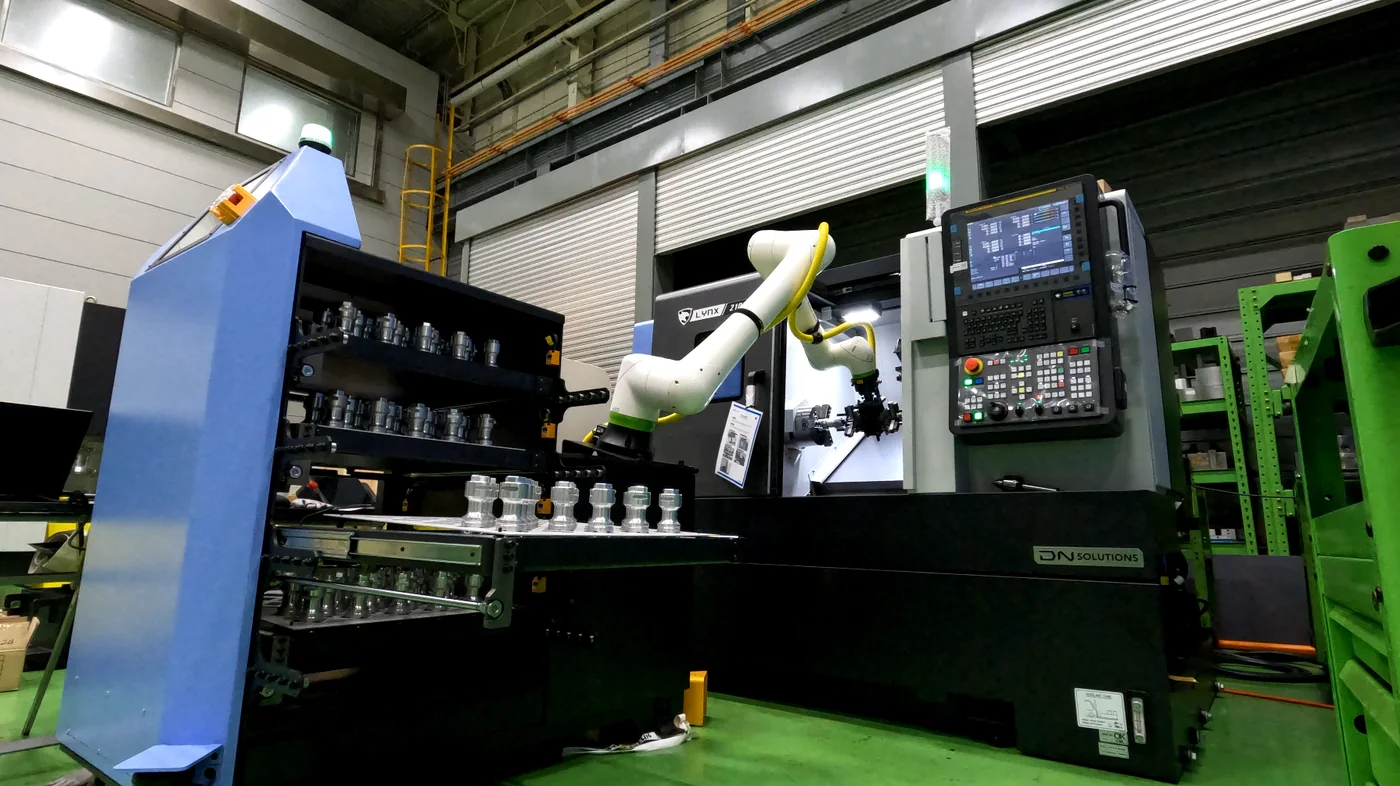
A CNC machine tending ROI calculation is useful only when it reflects how the shop will actually use the cell. The largest error is treating every operator hour as cash savings. If an operator is reassigned rather than removed from payroll, the financial benefit comes from the additional productive work, overtime avoided, capacity added or revenue protected. A credible model therefore starts with measured machine and labor data, states what will change after automation, and keeps one-time investment separate from recurring cost. This guide provides that model, including a simple payback formula, a worked example and a checklist for testing the assumptions before approval.
01Use the right ROI question
The weak question is, "How much labor does the robot replace?" The better question is, "What economic constraint changes when this machine is tended automatically?" Depending on the shop, the answer may be more spindle hours, fewer overtime hours, reduced waiting between cycles, better coverage through breaks, safer handling, steadier output or the ability to accept work that current staffing cannot support.
Document the baseline for one machine or one defined cell. Use actual history where possible: scheduled hours, machining hours, completed good parts, overtime, labor assignments, average delay between cycle complete and reload, scrap, rework and downtime causes. A week can be misleading if the mix is unusual. Several representative production periods are better.
The complete guide to CNC machine tending automation can help determine whether the process is stable enough for a financial model. Do not model a technically unrealistic unattended target. The business case must follow the application, not the other way around.
02Define the total installed investment
The investment is more than the robot. Include the complete scope required to reach production: robot and controller, part presentation, end-of-arm tooling, machine interface, automatic door if needed, chuck or fixture actuation, guarding and safety devices, engineering, installation, validation, training, freight and site preparation. Include optional equipment only if the business case depends on it.
Also include internal implementation effort that has a real opportunity cost. Examples are engineering review, maintenance support, network work, fixture modifications, project management and production time used for testing. A contingency can be appropriate when the machine condition or interface is not fully known.
Platform choice affects the engineering line too. A standardized machine tending platform such as Labot starts with a defined robot, part presentation, gripper, and user interface. Project engineering can then focus on what’s specific to the application, such as fingers, regripping, recipes and validation, instead of designing the whole cell from scratch. That usually means fewer engineering hours, a shorter schedule and a quote that’s easier to verify. Custom requirements still add cost, so ask which items are standard and which are application-specific.
Keep financing and tax treatment separate from the operating case unless finance has specified how to include them. A simple payback model normally compares cash investment with annual net operating benefit. A more complete capital review may also calculate net present value and internal rate of return. NIST manufacturing investment tools describe NPV and IRR as standard investment-analysis methods.
- Automation equipment and controls
- Machine modifications and interface work
- Grippers, fingers, fixtures and part presentation
- Safety equipment, risk assessment and validation
- Installation, training, freight and site preparation
- Internal implementation time and an evidence-based contingency
03Calculate annual labor impact without double counting
Start with the operator time that automation actually changes. A robot may remove repetitive loading from an assignment while the same employee continues setup, inspection, material replenishment, tool management and support for several machines. In that case, the full wage is not eliminated. The benefit is the value of reassigned capacity, overtime avoided, an open position not filled, temporary labor reduced, or added production enabled.
Use fully burdened labor cost only for the hours that truly change. Burden may include payroll taxes, benefits and other company-defined costs. Avoid adding both eliminated labor and the full value of extra output if the same reclaimed hours produce that output, unless the model clearly shows they are separate effects.
For labor-constrained shops, an opportunity-based method is often stronger. Estimate the contribution generated when a skilled person spends reclaimed time on setups, inspection, preventive work or another machine. State the assumption and cap it at available demand. A cell cannot create financial value from theoretical capacity that the business cannot sell or use.
04Value additional spindle utilization
Machine tending often creates value by shortening the gap between cycle complete and the next cycle start. The gap can be especially visible during breaks, shift changes, meetings or when one operator covers several machines. Measure the current waiting time rather than assuming it.
Added annual machining hours equal the reduction in average idle time per cycle multiplied by the annual number of cycles, plus verified unattended hours added outside the staffed schedule. Convert those hours into good parts using the demonstrated machining cycle and expected yield. Then value the good parts using contribution margin, not selling price. Contribution margin is revenue minus costs that rise with the additional production, such as material, consumable tooling, outside processing and other variable costs.
The model must respect demand and downstream capacity. If inspection, deburring, washing or assembly cannot absorb more output, only the usable increment belongs in the ROI. NIST research on manufacturing efficiency emphasizes that returns vary widely by investment type and operating context, which is a good reason to model the specific bottleneck rather than apply a universal percentage. See the NIST study on manufacturing ROI.
05Include quality, safety and delivery benefits carefully
Consistent loading can reduce variation caused by incorrect orientation, inconsistent seating or missed cleaning steps, but only if the fixture, gripper and verification method control those conditions. Use historical scrap and rework cost, estimate the portion tied to loading, and model only the reduction the cell can plausibly influence.
Safety improvements matter even when they are difficult to price. Removing repetitive door, chuck and part-handling tasks can reduce exposure, but a robot cell introduces its own hazards and requires an application-specific safety design. Do not convert avoided injuries into a speculative dollar amount just to improve payback. Track the safety objective separately and include actual insurance, ergonomic or incident costs only if finance approves the method.
Delivery benefits can be quantified when missed capacity currently causes premium freight, outsourcing, late penalties or lost orders. Use documented history and avoid counting both the avoided cost and the same incremental contribution margin twice.
06Subtract recurring operating costs
Annual net benefit is gross annual benefit minus recurring costs created by the automation. Include preventive maintenance, replacement fingers and wear items, software or support fees if applicable, energy and compressed air, periodic safety checks, planned service and realistic downtime. If the system requires an operator to replenish parts, inspect output or complete changeovers, include that remaining labor.
Do not assume either zero maintenance or an arbitrary percentage. Ask the supplier for maintenance requirements and identify parts that wear in the real application. A conservative model can include a base case and a downside case with lower availability or higher support cost.
The basic formulas are: Annual net benefit = labor impact + added contribution + avoided operating costs - new recurring costs. Simple payback in years = total installed investment / annual net benefit. Simple payback in months = simple payback in years multiplied by 12. ROI percentage for a chosen period = cumulative net benefit minus investment, divided by investment, multiplied by 100.
07Work through a transparent example
Consider a hypothetical cell with a total installed investment of $150,000. Verified labor and overtime impact is $58,000 per year. Added usable spindle capacity produces $72,000 of annual contribution margin. Avoided outsourcing and rework add $18,000. New maintenance, energy, consumables and support total $16,000 per year.
Annual net benefit = $58,000 + $72,000 + $18,000 - $16,000 = $132,000. Simple payback = $150,000 / $132,000 = 1.14 years, or about 13.6 months. This is an illustration, not a YC Robotech quote or a guaranteed result. Replace every number with your own measured or quoted input.
Now stress test the result. If added contribution is 25 percent lower and recurring cost is $5,000 higher, annual net benefit becomes $109,000 and payback becomes about 16.5 months. That downside case may still be acceptable, or it may show that the application needs a lower installed cost, more unattended hours or a different scope.
- Base case uses the most defensible expected inputs.
- Downside case lowers output, availability or demand and raises operating cost.
- Upside case is useful for planning, but it should not be the approval case.
- Record the owner and source for every assumption.
08Approve the project with operational gates
A purchase order should not be the final ROI checkpoint. Tie the business case to technical acceptance and post-launch review. Confirm that the quoted scope supports the modeled cycle, capacity, part mix and unattended hours. Define how good parts, intervention rate and changeover time will be measured during acceptance.
After launch, compare actual results with the model at 30, 60 and 90 days. If the cell is capable but planned benefits are not appearing, the constraint may be replenishment, scheduling, staffing, tool life, upstream material or downstream inspection. Correct the operating system before concluding that the robot failed financially.
The best CNC machine tending ROI model is not the one with the shortest number. It is the one management, operations and finance can all trace back to observed data, clear scope and measurable production outcomes.