

A low CNC machine tending quote is not automatically the best value. It may simply exclude work that another supplier has included, such as CNC interface changes, automatic door controls, gripper fingers, guarding, installation, runoff parts, training or safety validation. A reliable comparison begins by defining one installed system boundary and one acceptance test for every bidder. This guide shows how to normalize CNC machine tending proposals, identify hidden exclusions, compare technical risk and evaluate lifecycle support. For a breakdown of the cost categories themselves, start with the CNC machine tending automation cost guide. Then use the checklist below to determine whether each quote is complete enough to support a capital decision.
01Compare the complete production cell, not the robot arm
A robot arm, controller and teach device are visible line items, but they cannot load a CNC alone. The installed cell also needs a way to stage parts, an end-of-arm tool, a machine interface, safeguarding, controls, engineering, installation and production validation. Depending on the application, it may also need an automatic door, chuck or fixture actuation, air blow, part cleaning, gauging, marking, washing, deburring or finished-part handling.
Define the boundary before comparing prices. Does the quote include freight, rigging, electrical work, compressed air, floor anchoring, training, risk assessment, safety validation, runoff parts, travel and documentation? Does it include work on the CNC, or is that assigned to the buyer or machine builder? A lower quote can simply contain less scope.
The Labot machine tending systems are standardized platforms, which can reduce custom engineering for suitable applications. Even with a standardized platform, final cost still depends on the robot option, part presentation, workholding, machine interface and site requirements.
02Robot, controller and payload requirements
Robot cost changes with payload, reach, speed, mounting, environmental requirements and safety functionality. The required payload includes the gripper, fingers, adapters, hoses, sensors and the part. A heavier part can trigger a larger robot, which can also change the base, guarding, power and layout. Longer reach may be necessary for a large machine or a dual-machine cell.
Collaborative and traditional industrial robots are not interchangeable price categories. The correct choice follows the application and risk assessment. A collaborative robot may simplify some layouts, but the complete system may still require scanners, fencing or other safeguards because of the workpiece, tooling, speed or nearby CNC hazards. Traditional industrial robots can provide higher speed or payload where the cell is physically separated.
Ask whether the quote includes the exact robot model, controller, cables, mounting hardware, safety options and warranty. A phrase such as "robot included" is not enough for a capital comparison.
03Part presentation and unattended capacity
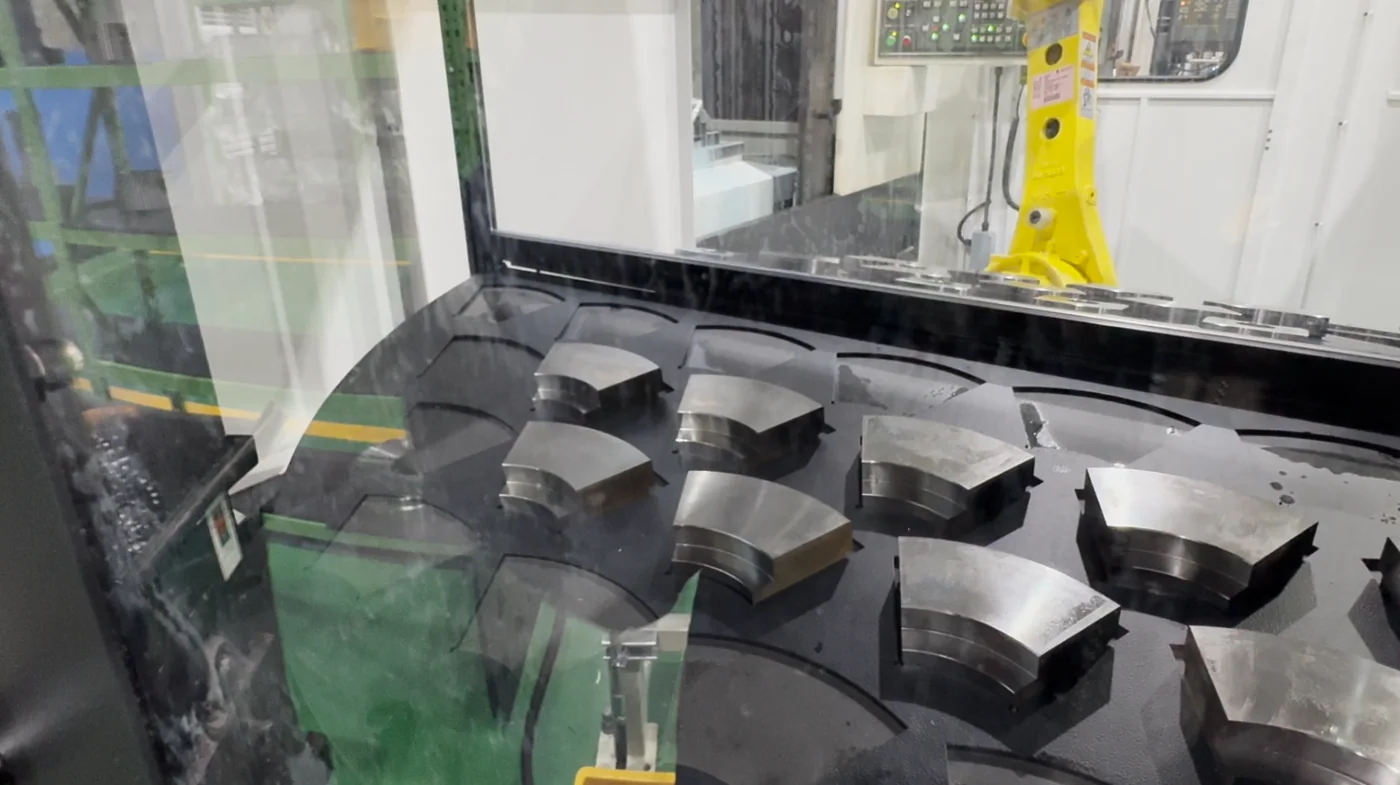
A tray may be economical for small, repeatable parts and modest autonomy. Drawers can organize multiple pallets in a compact footprint. Turntables can separate operator loading from the robot work zone. Carts can support offline loading and rapid exchange. Vision-guided bins can add flexibility, but they also add cameras, lighting, programming and process variation.
Capacity has a direct cost effect. More unattended time normally requires more raw-part locations, more finished-part space or a method for replenishment without stopping the cell. The calculation begins with machining cycle time and the required autonomy. An overnight run of eight hours at a 12-minute cycle requires at least 40 part positions in each material state before adding buffer.
Use the CNC automation readiness checklist to confirm that demand, part repeatability and upstream material can support the capacity being purchased. Paying for eight hours of storage has little value if tool life, inspection or scheduling limits the cell to two hours.
04End-of-arm tooling, workholding and process options
Simple parallel grippers with dedicated fingers can be cost-effective when geometry is stable. Cost rises when the cell needs dual grippers, automatic tool changing, custom fingers, compliance devices, force sensing, internal gripping, magnets, vacuum, part detection or multiple part families. The final design must handle raw-stock tolerance, coolant, chips, burrs and the finished geometry.
CNC workholding can also change the scope. An automation-ready chuck or fixture with confirmed open and closed states is easier to integrate than a manual fixture. Additional cost may include pneumatic or hydraulic actuation, valves, pressure switches, sensors, custom jaws and machine-builder support.
Secondary processes should be justified individually. Air blow or a fixed cleaning station may be essential for seating. In-process gauging may protect quality. Part marking or deburring may remove a separate operation. Each can improve the business case, but each also adds hardware, controls, validation and fault recovery.
- Gripper type and number of grippers
- Custom fingers and change parts
- Chuck, fixture, jaws and confirmation sensors
- Cleaning, gauging, marking, washing or deburring
- Reject handling and traceability requirements
05CNC interface, doors and integration engineering
The cell must exchange verified states with the CNC. Cost depends on available I/O, control generation, machine options, automatic door status, chuck or fixture controls, cycle start permissions and fault handling. A modern machine with documented robot-interface signals may require less custom work than an older machine with limited access to status and commands.
Automatic door equipment can be factory-installed, supplied by a third party or engineered for the application. The responsible party and warranty impact must be clear. The same applies to workholding modifications. Some machine builders require approved methods or direct involvement.
Integration engineering includes the sequence, PLC or robot logic, recipes, alarm messages, recovery behavior, documentation and testing. The CNC robot integration page explains why the make, model and control are essential inputs. A budget prepared without that information should be treated as provisional.
06Safety, site work and acceptance
Safeguarding is not an optional accessory. The cost may include fencing, interlocked doors, safety scanners, light curtains, safety PLC functions, emergency stops, signage and validation. The final design must come from the application risk assessment and applicable requirements. The fastest or least expensive concept is not acceptable if it leaves hazards uncontrolled.
Site cost can include electrical service, compressed air, network connection, floor preparation, rigging, anchors and changes needed to preserve maintenance access. Installation timing matters because production downtime has a real cost even when it is not on the supplier invoice.
Acceptance should be priced around a written production test. Define part count, good-part criteria, intervention limits, cycle expectations, changeover test, safety validation and documentation. Training should cover operation, changeover, recovery and maintenance responsibilities. If those items are excluded, include them separately in the capital request.
07Add lifecycle cost to the purchase comparison
The lowest installed price is not automatically the lowest cost of ownership. Estimate preventive maintenance, wear fingers, replacement grippers, safety-device inspection, software or support fees, energy, compressed air and planned service. Include the labor needed for replenishment, inspection and changeover.
Downtime risk belongs in the comparison. Ask about spare parts, remote support, response time, backups, documentation and the skills required for recovery. A system that operators can change over and recover consistently may create more value than a lower-cost cell that depends on a specialist for routine events.
Standardization can reduce lifecycle cost across multiple cells. Common robots, grippers, spare parts, interfaces and software shorten training and simplify support. The Smart EZ software workflow is designed to let operators configure compatible Labot applications through a guided process rather than writing robot code.
08Send every bidder the same request for quote
A responsible estimate needs enough application detail to identify the likely platform and major risks. Provide the items below and ask the supplier to state inclusions, exclusions, assumptions and the validity period. Quote from YC Robotech list what is included and what is excluded, so you can compare them line by line against other proposals. If two suppliers receive different information, their numbers cannot be compared fairly.
Avoid forcing a single number before the application is understood. A range with explicit assumptions is more useful than a precise figure built on guesses. After the concept is agreed and machine details are verified, request a firm proposal tied to scope and acceptance criteria.
- CNC make, model, control, serial number and current automation options
- Part drawings, material, raw and finished samples, dimensions and weight
- Machining cycle, annual demand, batch size and changeover frequency
- Current fixture or chuck and required confirmation signals
- Desired unattended time and required raw or finished capacity
- Available floor space, utilities and service-access constraints
- Quality checks, secondary operations and traceability needs
- Target installation window and written acceptance test